
Business travel rarely goes exactly according to plan.
A flight arrives later than expected. A meeting runs over. A client changes the location at the last minute. Traffic slows down the next appointment. A hotel is farther from the office than expected. Or a traveler arrives at the airport and realizes they still need to figure out how to get across the city.
For leisure travelers, these situations can be inconvenient.
For business travelers, they can affect an entire day of meetings, presentations, client conversations, and important decisions.
That is why transportation should be part of the business travel plan—not something arranged after everything else is already scheduled.
Whether you’re traveling to Washington, DC for a single meeting, attending a conference, visiting clients, or managing a multi-day executive itinerary, the right transportation plan can make the trip more organized and predictable.
Washington, DC can be particularly demanding for business travelers because an itinerary may involve Downtown DC, Capitol Hill, K Street, Georgetown, Northern Virginia, Maryland, and one of three major regional airports: DCA, IAD, or BWI. Those airports differ significantly in location and ground transportation logistics.
This guide covers the most important transportation tips for business travelers, including airport transfers, business meetings, chauffeur services, scheduling, vehicle selection, client transportation, and common mistakes to avoid.
Table of Contents
Why Transportation Planning Matters for Business Travelers
Business travel is usually built around a schedule.
A typical day might look something like:
7:30 AM: Airport arrival
9:00 AM: Hotel check-in
10:00 AM: Client meeting
12:00 PM: Lunch
2:00 PM: Office presentation
4:00 PM: Conference
6:30 PM: Client dinner
Every movement between those appointments has to fit into the schedule.
Transportation problems can create a chain reaction.
If the airport transfer is late, the hotel arrival is delayed. If the hotel departure is delayed, the first meeting starts late. If that meeting runs over, the next appointment becomes difficult to reach.
The goal of business travel transportation is therefore not simply to find a vehicle.
It is to create a transportation plan that supports the entire itinerary.
Professional corporate transportation in Washington, DC is commonly used for airport transfers, executive meetings, client travel, conferences, roadshows, and multi-stop schedules.
1. Plan Transportation Before You Book Your Trip
One of the easiest mistakes business travelers make is booking the flight and hotel first and thinking about ground transportation later.
Instead, consider transportation while building the itinerary.
Before your trip, identify:
- Arrival airport
- Departure airport
- Hotel
- Meeting locations
- Conference venue
- Client offices
- Dinner locations
- Estimated travel times
- Number of passengers
- Luggage requirements
- Any special transportation requirements
Then look at the entire day rather than individual rides.
For example:
DCA → Hotel → Client Office → K Street → Conference Center → Hotel
may be better handled as one coordinated transportation plan rather than several unrelated bookings.
Planning this early also gives you time to choose between point-to-point transportation and an hourly chauffeur service when the itinerary requires multiple stops.
2. Choose Transportation Based on Your Itinerary
There is no single transportation option that is best for every business traveler.
A simple airport-to-hotel trip is different from a full day of meetings.
Point-to-point transportation
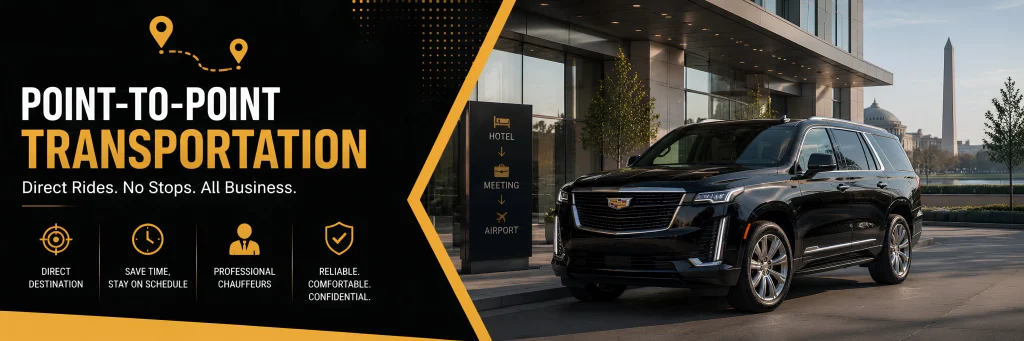
This works well when you know exactly where you need to go.
Examples include:
- Airport to hotel
- Hotel to office
- Office to airport
- Hotel to conference center
Hourly chauffeur service
This can be more practical when your schedule includes several stops.
For example:
Hotel → Meeting → Client Office → Conference → Dinner
Instead of arranging a new ride after every appointment, a chauffeur can remain available during the booked period.
Washington-area providers currently market hourly chauffeur service specifically for multi-stop corporate travel, meetings, events, and flexible schedules.
The right choice depends on your itinerary, not simply the vehicle you prefer.
3. Book Airport Transportation in Advance
Airport transportation is one area where last-minute planning can create unnecessary stress.
A business traveler may have a meeting scheduled shortly after landing.
That means the transportation plan needs to account for:
- Flight arrival
- Baggage collection
- Pickup procedures
- Traffic
- Ground transportation
- Hotel or office arrival
- Meeting preparation
Pre-arranging an airport car service allows the ground transportation portion of the trip to be planned before the traveler leaves home.
Many professional airport transportation providers serving the Washington area offer flight monitoring and scheduled airport pickups.
This is particularly useful for executives who don’t want to start searching for transportation immediately after landing.
4. Know Which Washington DC Airport You’re Using
One of the most important transportation tips for business travelers visiting Washington, DC is simple:
Know your airport.
The region is served by:
- Ronald Reagan Washington National Airport
- Washington Dulles International Airport
- Baltimore/Washington International Airport
These airports are not interchangeable from a ground transportation perspective.
They have different locations, routes, pickup procedures, and typical travel considerations. DCA is close to central Washington, while IAD and BWI are substantially farther from many central business destinations.
When booking transportation, always provide the exact airport and terminal information available to you.
5. Build a Realistic Travel Schedule
A common business travel mistake is creating an itinerary that looks perfect on paper but leaves no room for reality.
For example:
Meeting ends at 2:00 PM
Next meeting starts at 2:30 PM
If the locations are across the metropolitan area, that may be too tight.
Your transportation schedule should account for:
- Traffic
- Building access
- Security
- Elevator time
- Parking or loading areas
- Walking between locations
- Meeting overruns
- Airport procedures
A realistic schedule doesn’t mean adding hours to every trip.
It means recognizing that arrival time and meeting start time are not the same thing.
For important meetings, arriving early can be far more valuable than arriving exactly at the scheduled start time.
6. Don’t Forget About Parking
Business travelers often calculate transportation based only on driving time.
That’s incomplete.
Consider the entire process:
Drive → Find parking → Park → Walk → Enter building
A short drive can become a much longer transportation experience when parking is difficult.
This is particularly relevant in dense business areas where parking may be limited or inconvenient.
Using a professional chauffeur can remove parking responsibilities from the traveler and allow the passenger to focus on the meeting instead.
That doesn’t necessarily make the road journey shorter.
It simply changes what the traveler has to do during that time.
7. Use Travel Time Wisely
Travel time doesn’t have to be completely unproductive.
A business traveler sitting in a professionally driven vehicle may be able to:
- Review a presentation
- Read a proposal
- Respond to emails
- Make business calls
- Review meeting notes
- Prepare questions
- Organize the next appointment
- Take a short break
The vehicle becomes a transition between appointments rather than another task the executive has to manage.
This is one reason executive chauffeur services are often positioned as productivity-focused transportation rather than simply luxury travel.
Of course, not every passenger should work during a ride.
Sometimes the best use of the time is simply preparing mentally for the next meeting.
8. Choose a Chauffeur When Your Schedule Has Multiple Stops
If you’re traveling to one destination and back, a standard point-to-point service may be enough.
But complicated schedules can benefit from a different approach.
Consider this itinerary:
8:00 AM — Hotel
9:00 AM — Client meeting
11:00 AM — Corporate office
1:00 PM — Lunch
3:00 PM — Conference
6:00 PM — Dinner
8:30 PM — Hotel
Arranging each ride separately creates more opportunities for delays and coordination problems.
An hourly chauffeur service can provide continuity throughout the itinerary.
This is especially useful for:
- Executive roadshows
- Investor meetings
- Client tours
- Government appointments
- Corporate events
- Multi-office visits
- Conference schedules
9. Share Accurate Pickup Information
A transportation reservation is only as useful as the information behind it.
When booking, provide as much accurate information as possible.
That may include:
- Full pickup address
- Building name
- Hotel name
- Entrance or preferred pickup point
- Flight number
- Destination address
- Passenger name
- Number of passengers
- Luggage requirements
- Special instructions
- Contact information
For a large office complex, “123 Main Street” may not be enough.
The driver may need to know which entrance or building the passenger will use.
Clear information reduces unnecessary communication on the day of travel.
10. Provide Your Flight Details for Airport Transfers
If you’re booking airport transportation, provide the correct flight information whenever possible.
This gives the transportation provider useful context about your arrival.
For business travelers, this can be particularly important when the schedule after landing is tight.
A flight number is much more useful than simply saying:
“I’ll arrive around 3 PM.”
Professional airport transportation providers in the DC area commonly use flight information to monitor arrival changes and coordinate pickups.
If your flight changes, update the transportation provider as soon as practical.
11. Keep Your Transportation Provider Updated
Business schedules change.
- A meeting may finish early.
- A presentation may run late.
- A client may move dinner to another location.
- A flight may be delayed.
Don’t assume the transportation provider automatically knows that your itinerary changed.
If something changes, communicate it.
A single updated message can prevent confusion later.
For corporate travel, having one designated transportation contact can also make communication easier, particularly when an executive assistant or travel manager is coordinating the itinerary.
12. Plan Transportation Between Business Meetings
Don’t think only about the first and final trip.
The transportation between meetings can be just as important.
Suppose you’re attending meetings at:
Downtown DC → Arlington → Bethesda
Those locations may require different travel routes and timing considerations.
Before the trip, review the order of the meetings and consider whether the sequence makes sense geographically.
If you have flexibility, grouping nearby appointments can reduce unnecessary movement.
This is one of the simplest ways to improve a business travel itinerary without increasing the number of transportation services you book.
13. Choose the Right Vehicle for Your Business Trip
The best vehicle depends on the trip.
Executive Sedan
A sedan may be appropriate for one or two business travelers who want a discreet and comfortable ride.
Luxury SUV
An SUV can make more sense when you have additional luggage or want more passenger space.
Executive Sprinter
A Sprinter-style vehicle can be useful for teams traveling together, especially for corporate events, conferences, roadshows, or airport group transfers.
The important question isn’t:
“Which vehicle looks the most impressive?”
It’s:
“Which vehicle fits the people, luggage, itinerary, and purpose of this trip?”
Current corporate transportation providers in the DC area offer different vehicle categories based on passenger count, luggage, and business itinerary requirements.
14. Don’t Forget Your Luggage
Luggage can affect the transportation choice more than many travelers realize.
One executive with a small carry-on has different requirements from:
- Four executives
- Multiple checked bags
- Conference equipment
- Presentation materials
- Product samples
Before booking, consider both passenger capacity and luggage capacity.
A vehicle that technically seats four people may not be comfortable if those four people also have several large bags.
15. Consider Privacy When Business Discussions Are Involved
Not every business conversation should happen in a crowded public environment.
Executives may need to discuss:
- Client strategy
- Project details
- Schedules
- Presentations
- Internal decisions
- Business development
- Upcoming meetings
For some travelers, a private vehicle offers a more appropriate environment for confidential work or conversations.
Privacy requirements vary by trip, so businesses should discuss them with the transportation provider when booking.
Corporate chauffeur services in Washington, DC commonly position discretion and privacy as part of executive transportation.
16. Arrange Transportation for Clients and Business Guests
If you’re bringing a client or business partner to Washington, DC, transportation should be part of the hospitality plan.
A visiting client may not know:
- Which airport is most convenient
- Where to meet the driver
- How long the trip will take
- Where to park
- Which route to use
- How to get between multiple meetings
Arranging professional transportation gives the guest one less thing to manage.
It also helps your company control the transportation experience from the moment the client arrives.
This is particularly useful for:
- VIP clients
- Visiting executives
- Investors
- Speakers
- Business partners
- Conference guests
17. Think About the Entire Business Trip, Not Just One Ride
A common mistake is booking transportation separately for every stage of the trip without looking at the bigger picture.
Instead, map the entire journey.
Arrival Day
Airport → Hotel → Dinner
Meeting Day
Hotel → Office → Client → Conference → Dinner
Departure Day
Hotel → Meeting → Airport
Once you see the complete itinerary, it becomes easier to determine where you need:
- Point-to-point service
- Hourly chauffeur service
- Airport transportation
- Group transportation
- Client transportation
This approach can also prevent unnecessary duplicate bookings.
18. Consider a Corporate Transportation Account for Frequent Travel
If your company only needs transportation once a year, individual reservations may be perfectly adequate.
But frequent business travelers may benefit from a corporate transportation arrangement.
Depending on the provider, corporate programs can include:
- Centralized reservations
- Multiple authorized users
- Recurring bookings
- Account management
- Consolidated billing
- Trip records
- Traveler profiles
Current corporate transportation programs in the Washington area advertise centralized account management and billing designed for businesses that arrange transportation regularly.
This can be especially useful for executive assistants and travel coordinators.
19. Keep a Single Transportation Contact for Complex Trips
Complex business travel becomes harder when several people are communicating different instructions.
For example:
- The executive tells the driver one pickup time.
- The assistant sends another.
- The event planner changes the location.
- The client expects a different arrival time.
A single point of contact can help prevent this.
For a major business trip, designate one person—often an executive assistant, travel manager, or event coordinator to communicate transportation updates.
This creates a clearer chain of communication.
20. Don’t Rely Entirely on the Cheapest Transportation Option
Price matters.
But for business travel, it shouldn’t be the only factor.
A cheaper option may not be the best choice if it creates:
- More waiting
- More coordination
- Less predictability
- Multiple separate bookings
- Difficulty handling schedule changes
- Limited vehicle options
Instead of asking only:
“What’s the cheapest ride?”
ask:
“Which transportation option gives me the right balance of reliability, convenience, time, and cost for this itinerary?”
That is a much better business-travel decision.
21. Know When Rideshare Makes Sense
Professional chauffeur service isn’t automatically the best choice for every trip.
A rideshare may work perfectly well for:
- Short personal trips
- Simple point-to-point travel
- Flexible schedules
- Situations where executive-level service isn’t necessary
The equation changes when you’re dealing with:
- Important clients
- Multiple meetings
- Airport schedules
- Executive travel
- Corporate events
- Full-day itineraries
- VIP guests
For those situations, a dedicated corporate car service may provide a more structured experience.
Washington-area corporate transportation providers commonly distinguish between simple point-to-point trips and more involved hourly or multi-stop services.
22. Avoid These Common Transportation Mistakes
Booking Too Late
Last-minute transportation can limit vehicle availability and create unnecessary stress.
Giving an Incomplete Address
Large buildings and campuses often have multiple entrances.
Forgetting the Airport
DCA, IAD, and BWI are very different transportation situations.
Leaving No Buffer
A 20-minute gap between appointments may not be enough for a cross-region trip.
Booking the Wrong Vehicle
Always consider passengers and luggage together.
Arranging Every Ride Separately
A complicated itinerary may be easier with hourly service.
Forgetting the Return Trip
Business travelers sometimes focus heavily on arrival and leave the departure transportation until the last minute.
Not Updating Schedule Changes
If your meeting moves, your transportation provider needs to know.
Ignoring the Client Experience
If a client is visiting, transportation is part of their overall experience with your company.
23. Create a Simple Business Travel Transportation Checklist
Before your trip, confirm the following:
Trip Details
- Arrival airport confirmed
- Departure airport confirmed
- Hotel confirmed
- Meeting locations confirmed
- Event venue confirmed
Transportation
- Airport transportation booked
- Meeting transportation arranged
- Return transportation arranged
- Hourly service considered for multi-stop days
- Correct vehicle selected
Passenger Information
- Passenger names provided
- Number of passengers confirmed
- Luggage requirements considered
- Special requests communicated
Airport
- Flight number provided
- Arrival time confirmed
- Pickup instructions understood
Schedule
- Travel buffers included
- Meeting times reviewed
- Traffic considered
- Client transportation arranged if needed
Communication
- Transportation provider’s contact saved
- One trip coordinator identified
- Schedule changes communicated promptly
This simple checklist can prevent many avoidable transportation problems.
24. How Business Travelers Can Make Transportation More Efficient
The best transportation strategy is usually proactive.
Instead of asking:
“How do I get there?”
at every stage of the trip, answer these questions before you leave:
- Where am I going?
- When do I need to arrive?
- How many people are traveling?
- How much luggage is involved?
- Will I have multiple stops?
- Will parking be difficult?
- Do I need privacy?
- Will I need a vehicle waiting between meetings?
- Am I transporting a client or VIP?
Once you answer these questions, the right transportation option becomes much easier to identify.
Chauffeur vs. Rideshare vs. Taxi for Business Travelers
There isn’t one universal winner.
Chauffeur
Best suited for:
- Executives
- VIP clients
- Multi-stop itineraries
- Airport transfers
- Corporate meetings
- Full-day schedules
- Business travelers who value predictable planning
Rideshare
Best suited for:
- Simple trips
- Flexible schedules
- Individual travelers
- Short point-to-point transportation
Taxi
Best suited for:
- Immediate local transportation
- Travelers who prefer traditional taxi service
- Simple trips where pre-arranged executive service isn’t necessary
For an important business itinerary, the decision should be based on schedule, reliability, complexity, passenger needs, and overall travel requirements, not simply the advertised fare.

How to Choose a Corporate Transportation Service in Washington DC
If you’re booking transportation for yourself, your executive, or a client, evaluate the provider before making the reservation.
Look for Local Experience
Washington, DC business travel can involve the District, Maryland, and Northern Virginia in the same itinerary.
Check Airport Coverage
If airport transportation is important, confirm that the provider serves DCA, IAD, and BWI.
Ask About Chauffeurs
A professional chauffeur should understand punctuality, communication, discretion, and corporate etiquette.
Review Fleet Options
Make sure the company has a vehicle appropriate for your passenger count and luggage.
Ask About Hourly Service
This can be valuable for meetings, roadshows, and events.
Understand the Booking Process
A professional provider should make it easy to communicate pickup details and schedule changes.
Ask About Corporate Accounts
If your company travels regularly, account management and centralized billing may save administrative time.
Consider Communication
For business travel, knowing how to reach the transportation provider matters.
The goal isn’t simply to find a company with nice vehicles.
The goal is to find a transportation partner that understands the business itinerary behind the ride.
When Should Business Travelers Hire a Chauffeur?
A chauffeur isn’t necessary for every trip.
Consider one when:
- You’re attending several meetings in one day.
- You’re traveling with a client.
- You’re visiting Washington, DC for the first time.
- You’re arriving at or departing from an airport on a tight schedule.
- Parking would be inconvenient.
- You need a vehicle available between appointments.
- You’re traveling with several colleagues.
- You’re attending a conference or corporate event.
- You need a professional and private travel environment.
- Your schedule is too important to leave transportation to chance.
For a simple trip, point-to-point transportation may be enough.
For a complicated itinerary, a chauffeur can make the entire day easier to coordinate.
Frequently Asked Questions
What is the best transportation option for business travelers?
The best option depends on the itinerary. Rideshare or taxi can work for simple trips, while professional chauffeur or corporate car service is often more suitable for executives, airport transfers, multi-stop schedules, clients, and important business events.
Should business travelers book airport transportation in advance?
Yes. Pre-booking gives you a transportation plan before you arrive and can be particularly useful when you have a meeting shortly after landing.
What information should I provide when booking business transportation?
Provide the exact pickup and destination addresses, passenger information, flight details for airport transfers, number of passengers, luggage requirements, and any important pickup instructions.
Which airports serve Washington, DC?
The three major airports used by travelers to the Washington region are DCA, IAD, and BWI. They have different locations and transportation considerations.
Is chauffeur service useful for multiple business meetings?
Yes. Hourly chauffeur service can be particularly practical when an executive has several appointments and needs transportation available between locations.
How far in advance should business travelers book transportation?
For important trips, booking as early as practical is a good approach, especially when traveling during busy periods, attending major events, or requiring a specific vehicle.
Can a chauffeur take me to multiple business locations?
Yes. Depending on the service structure, hourly or as-directed transportation can be used for multiple meetings, client visits, events, and other stops.
Should I use a chauffeur or Uber for a business trip?
For a simple trip, either may work. A chauffeur becomes more attractive when reliability, privacy, multiple stops, airport coordination, client service, or a professional executive experience is important.
Can companies arrange transportation for clients?
Yes. Businesses can arrange airport transfers, meeting transportation, hotel transfers, event transportation, and other ground transportation for clients and visiting executives.
What should I look for in a Washington DC corporate car service?
Look for professional chauffeurs, appropriate vehicles, reliable scheduling, airport coverage, hourly service, clear communication, corporate account options, and experience handling business travel throughout DC, Maryland, and Northern Virginia.
Final Thoughts
Business travel should be about the business, not constantly figuring out how to get from one appointment to the next.
A good transportation plan starts before the trip.
- Know your airports.
- Build realistic travel time into your schedule.
- Confirm your pickup details.
- Choose the right vehicle.
- Plan for multiple stops.
- Give yourself room for unexpected delays.
- And choose a transportation option that matches the importance and complexity of your itinerary.
For travelers visiting Washington, DC, planning is particularly important because a single business day can involve multiple areas across the District, Maryland, and Northern Virginia, as well as DCA, IAD, or BWI.
When the schedule is simple, a basic point-to-point ride may be all you need.
When the schedule includes executives, clients, airports, meetings, conferences, and multiple destinations, professional corporate transportation in Washington, DC can provide a more organized solution.
The best transportation choice is ultimately the one that supports your business schedule rather than becoming another problem you have to manage.
Make Your Next Business Trip Easier
If you’re planning executive travel, airport transportation, client visits, business meetings, or a multi-stop itinerary in Washington, DC, DC Elite Limo can help you build transportation around your schedule.
Request your corporate transportation plan today and keep your business trip moving.
How Companies Save Time with Chauffeurs
Corporate Event Transportation Planning: A Complete Guide for Washington DC Businesses
Corporate Transportation Guide for Washington DC Businesses
Benefits of Hiring a Chauffeur for Business Meetings
Chauffeur vs Taxi: Which Is the Better Choice for Your Next Trip?