Planning a successful corporate event involves much more than choosing a venue, sending invitations, and creating an agenda.
Transportation is one of the operational details that can determine whether the event feels organized or chaotic.
Guests need to know where to go. Executives may arrive at different airports. VIPs may require private transportation. Employees may need hotel-to-venue shuttles. Conference attendees may have different schedules. And if several hundred people are moving between multiple locations, even a small transportation mistake can create significant delays.
That’s why corporate event transportation planning should be part of the event strategy from the beginning, not something added a few days before the event.
For businesses hosting conferences, executive meetings, corporate dinners, networking events, retreats, conventions, or VIP gatherings in Washington, DC, a well-designed transportation plan can improve the guest experience while making logistics easier for the event team.
This guide explains how to plan corporate event transportation in Washington DC, choose appropriate vehicles, coordinate airport and hotel transportation, manage multiple vehicles, prepare for delays, and avoid common mistakes.
Table of Contents
Why Corporate Event Transportation Planning Matters
Corporate events often involve people who don’t know the area, don’t have their own transportation, or are traveling on tight schedules.
A typical Washington, DC corporate event might involve:
- Executives arriving at DCA
- International guests arriving at IAD
- Employees traveling from local offices
- Attendees staying at several hotels
- VIP guests requiring private transportation
- Conference sessions at a central venue
- A corporate dinner at a separate location
- Evening transportation back to hotels
Without a transportation plan, each movement becomes another problem for the event organizer to solve.
A professional transportation plan brings these movements together into one coordinated system.
The goal isn’t simply to move people from Point A to Point B.
The goal is to make sure the right people are in the right vehicles at the right locations at the right times.
Washington, DC event transportation providers commonly build services around conference shuttles, airport transfers, executive transportation, hotel movements, VIP travel, and multi-location event logistics.
What Is Corporate Event Transportation?
Corporate event transportation is the organized movement of employees, executives, clients, speakers, VIP guests, and other attendees to and from business events.
It can include:
- Airport transfers
- Hotel transportation
- Conference shuttles
- Corporate meeting transportation
- Executive transportation
- VIP transportation
- Event venue transfers
- Corporate dinner transportation
- Employee transportation
- Multi-stop transportation
- Hourly chauffeur service
- Group transportation
The exact transportation solution depends on the size and structure of the event.
A small executive meeting may require two luxury SUVs.
A 200-person conference may require several shuttle vehicles operating on a scheduled route.
A high-level corporate retreat may require a combination of private executive vehicles and larger group transportation.
The key is matching the transportation plan to the event rather than choosing vehicles first and trying to make the itinerary fit afterward.
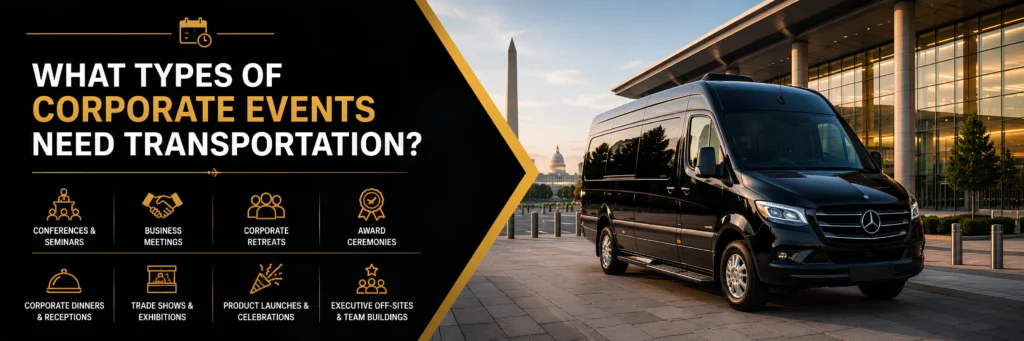
What Types of Corporate Events Need Transportation?
Not every corporate event requires a complex transportation program.
However, transportation becomes particularly important when attendees are traveling from different locations or when the event involves multiple venues.
Corporate Conferences
Conferences often involve large groups traveling between hotels, airports, convention centers, restaurants, and networking venues.
A coordinated shuttle schedule can make these movements easier for attendees.
Business Meetings
Smaller executive meetings may require private transportation for:
- CEOs
- Investors
- Clients
- Board members
- Senior executives
- Visiting business partners
Luxury sedans and SUVs can provide a more personalized experience for these passengers.
Corporate Retreats
Corporate retreats often take place away from the company’s main office.
Employees may need transportation from airports, hotels, or offices to the retreat location.
A dedicated transportation plan can help keep the group together and reduce confusion.
Trade Shows and Conventions
Trade shows can involve large numbers of attendees, exhibitors, speakers, and corporate teams.
Transportation may be needed between:
- Hotels
- Convention centers
- Airports
- Off-site meeting locations
- Restaurants
- Networking venues
Corporate Dinners and Receptions
Even when the primary event takes place at a single venue, guests may need transportation to and from hotels or other event locations.
This becomes particularly important when executives or VIP guests are attending.
Product Launches and Corporate Celebrations
A product launch or company celebration often involves multiple guest categories.
Employees, executives, clients, partners, and media representatives may all have different transportation requirements.
How to Plan Corporate Event Transportation Step by Step
The most effective approach is to start planning transportation before finalizing the event itinerary.
Here’s a practical framework.
Step 1: Build a Complete Guest List
Start by determining who actually needs transportation.
Don’t simply count the total number of attendees.
Divide passengers into categories.
For example:
VIP Guests
- CEOs
- Investors
- Key clients
- Speakers
- Board members
- Senior executives
General Attendees
- Employees
- Conference attendees
- Business partners
- Guests
Special Transportation Needs
- Guests arriving with large amounts of luggage
- Guests requiring accessible transportation
- Guests traveling as families
- Guests requiring private transportation
This segmentation makes vehicle planning much easier.
Step 2: Identify Every Transportation Point
Create a list of every location involved in the event.
This could include:
- DCA
- IAD
- BWI
- Hotels
- Corporate offices
- Convention centers
- Restaurants
- Event venues
- Meeting locations
- Airports
- Parking facilities
Don’t assume transportation only matters between the hotel and event venue.
Consider the entire guest journey.
For example:
Airport → Hotel → Conference → Lunch → Evening Reception → Hotel → Airport
Each movement should be considered when creating the transportation plan.
Step 3: Separate Private and Group Transportation
One of the most important planning decisions is determining which passengers should travel privately and which can share transportation.
A CEO arriving for an important board meeting may be better suited to a private luxury sedan.
A group of 12 employees attending the same conference may be better suited to an executive Sprinter vehicle.
A large conference may require several shuttle vehicles.
Using the same transportation solution for everyone isn’t always the most efficient approach.
Step 4: Choose the Right Vehicles
Vehicle selection should be based on more than passenger capacity.
Consider:
- Number of passengers
- Luggage
- Trip duration
- Number of stops
- VIP requirements
- Comfort
- Event image
- Pickup locations
For DC Elite Limo, different fleet options can support different corporate travel scenarios.
Luxury Sedan
Ideal for:
- Individual executives
- CEOs
- VIP clients
- Airport transfers
- Private business meetings
Luxury SUV
Useful for:
- Small executive groups
- VIP guests
- Passengers with luggage
- Longer business itineraries
Executive Sprinter
Useful for:
- Small corporate groups
- Conference attendees
- Executive teams
- Group airport transfers
For larger transportation requirements, the event planner may need multiple vehicles or a dedicated group transportation solution.
The objective is not simply to fill every seat.
It is to provide an appropriate combination of capacity, comfort, schedule, and service level.
Step 5: Create a Transportation Schedule
Once the passengers and vehicles are identified, build a detailed schedule.
Include:
- Pickup time
- Pickup location
- Passenger group
- Vehicle
- Driver/chauffeur assignment
- Destination
- Expected arrival time
- Return time
- Backup plan
A simple transportation schedule might look like:
| Time | Movement | Passenger Group |
| 8:00 AM | DCA → Hotel | VIP Executive |
| 9:00 AM | Hotels → Conference Venue | General Attendees |
| 12:30 PM | Conference → Lunch | Executive Group |
| 5:30 PM | Conference → Hotel | Attendees |
| 7:00 PM | Hotels → Dinner Venue | VIP Guests |
| 10:00 PM | Dinner → Hotels | Guests |
This kind of schedule gives the event team a clear operational picture.
Step 6: Plan Hotel-to-Venue Transportation
Hotel transportation is one of the most overlooked parts of corporate event planning.
Attendees may stay at different properties.
If everyone is expected to arrive at a conference venue at 8:30 AM, determine:
- Which hotels need transportation?
- How many passengers are at each hotel?
- What pickup time is required?
- How many vehicles are needed?
- Will vehicles make multiple hotel stops?
- Is a dedicated shuttle route better?
For larger events, multiple scheduled shuttle windows may work better than one departure.
For example:
7:00 AM — Early departure
7:30 AM — Standard departure
8:00 AM — Final departure
This gives attendees flexibility while preventing everyone from attempting to leave at the same time.
Step 7: Coordinate Airport Arrivals
Corporate events often involve attendees traveling from across the country or internationally.
Washington, DC businesses may need to coordinate arrivals at:
- Ronald Reagan Washington National Airport (DCA)
- Washington Dulles International Airport (IAD)
- Baltimore/Washington International Airport (BWI)
Airport transportation should be planned separately from local event transportation.
Create an arrival manifest that includes:
- Passenger name
- Airline
- Flight number
- Arrival date
- Arrival time
- Airport
- Hotel
- Vehicle assignment
- Contact information
Accurate flight details are especially important because arrival times can change.
Flight tracking and coordinated airport pickup services are common components of corporate event transportation programs in the Washington, DC market.
Step 8: Plan for VIP Guests Separately
VIP transportation should not be treated as an afterthought.
Determine in advance whether VIPs require:
- Private vehicles
- Dedicated chauffeurs
- Airport meet-and-greet
- Direct hotel transfers
- Separate event entrances
- Multiple stops
- Hourly availability
A VIP guest may have a completely different itinerary from the rest of the event attendees.
Giving that itinerary its own transportation plan makes coordination easier.
Step 9: Plan the Return Journey
Many event planners focus heavily on getting people to the event.
The return journey can be even more complicated.
After a conference or corporate dinner, everyone may want to leave at approximately the same time.
That can create a transportation bottleneck.
Determine:
- Which guests leave first?
- Which vehicles are waiting?
- Where are vehicles staged?
- What is the pickup location?
- How will guests identify their vehicle?
- Is another event happening nearby?
- What happens if the event runs late?
A clear departure plan prevents confusion at the end of the night.
Washington DC Traffic Should Be Part of the Plan
Washington, DC transportation planning requires more than looking at the distance between two addresses.
Traffic conditions, construction, special events, security activity, road closures, and congestion can affect travel times.
That means event planners should avoid building schedules around the assumption that every trip will take exactly the same amount of time.
Instead, create reasonable time buffers.
For example, if a guest must arrive at a meeting at 9:00 AM, don’t schedule transportation around a theoretical 20-minute drive and assume everything will go perfectly.
Allow time for:
- Traffic
- Loading and unloading
- Security
- Parking or staging
- Passenger delays
- Unexpected road conditions
A transportation schedule should be realistic, not optimistic.
Corporate Event Transportation for Washington DC Venues
Washington, DC has a wide range of venues suitable for business events.
Transportation planning may involve locations such as:
- Walter E. Washington Convention Center
- National Harbor
- Embassy Row
- Downtown Washington
- Union Station
- Major hotels
- Corporate offices
- Private event venues
Current local transportation providers specifically market transportation around major conference and event locations such as the Walter E. Washington Convention Center and National Harbor.
The important point is to identify the exact pickup and drop-off areas in advance.
A venue may have specific loading areas or operational restrictions that affect how vehicles should be positioned.
Conference Transportation Planning
Conferences require a slightly different approach from smaller corporate meetings.
There may be hundreds of attendees, multiple hotels, several event sessions, and different arrival and departure times.
A successful conference transportation plan should include:
Hotel Shuttle Routes
Determine which hotels require transportation and group them into efficient routes.
Conference Venue Schedule
Match shuttle arrivals to the event’s actual schedule.
Airport Transfers
Separate airport arrivals from regular conference shuttle operations.
VIP Transportation
Give executives, speakers, and VIP guests dedicated transportation when appropriate.
Evening Events
Plan transportation for dinners, receptions, networking events, and off-site activities.
Final Departure
Coordinate airport departures and hotel checkouts.
For larger events, professional transportation companies may provide dedicated account management, shuttle coordination, dispatch, and transportation management support.
Corporate Event Hotel Shuttle Planning
Hotel shuttles can be extremely effective when many attendees are staying at the same property or nearby properties.
However, don’t assume that one shuttle route will work for every event.
Consider:
- Number of hotels
- Number of attendees per hotel
- Distance between hotels
- Venue location
- Event start time
- Event end time
- Expected traffic
- Number of available vehicles
For example, three hotels with 40 attendees each may require a different solution from one hotel with 120 attendees.
The transportation plan should follow the passenger distribution.
VIP and Executive Event Transportation
VIP transportation is about more than using a luxury vehicle.
The service should be coordinated around the guest’s schedule.
For executives, consider:
- Private pickup
- Airport transportation
- Hotel transfer
- Meeting transportation
- Event venue arrival
- Dinner transportation
- Return transportation
If the executive has multiple appointments, an hourly chauffeur arrangement may be more practical than arranging individual rides.
This gives the passenger a consistent vehicle and chauffeur throughout the itinerary.
Managing Multiple Vehicles at Corporate Events
Large events may require several vehicles operating simultaneously.
This is where transportation planning becomes more complex.
For example, an event could require:
- 2 vehicles for VIP guests
- 4 vehicles for hotel shuttles
- 1 vehicle for airport arrivals
- 1 vehicle for executives
- Additional vehicles for evening transportation
Every vehicle needs a clear assignment.
A transportation manifest should identify:
- Vehicle
- Chauffeur
- Passenger group
- Pickup location
- Destination
- Departure time
- Contact information
The event coordinator should also know who is responsible for transportation communication.
Professional event transportation companies in Washington, DC commonly provide coordinated group movements, multiple vehicle options, account management, and logistics support for larger programs.
Create a Transportation Communication Plan
Even a perfect transportation schedule can fail if attendees don’t know what to do.
Before the event, provide guests with clear information.
Tell them:
- Where to meet the vehicle
- Pickup time
- Hotel pickup location
- Event departure time
- Contact information
- What to do if they miss the shuttle
- How VIP transportation differs
- Where to wait after the event
For larger conferences, digital communication or real-time shuttle information can further simplify attendee coordination. Some event transportation providers now use technology to provide shuttle location and pickup information to attendees.
Build a Backup Plan
Every corporate event transportation plan should have a contingency strategy.
Ask:
- What happens if a vehicle is delayed?
- What happens if an event runs late?
- What happens if an attendee misses a scheduled shuttle?
- What happens if flight information changes?
- What happens if traffic significantly increases travel time?
A backup plan may include:
- Additional transportation capacity
- Flexible chauffeur availability
- Alternate pickup locations
- Extra travel time
- Secondary routes
- Updated passenger manifests
- Direct communication with the transportation coordinator
You don’t necessarily need a backup vehicle for every passenger.
But you should know what happens when something doesn’t go according to plan.
How Much Does Corporate Event Transportation Cost?
There is no single price for corporate event transportation in Washington, DC.
The cost depends on the complexity of the event.
Important factors include:
Number of Passengers
More passengers may require more or larger vehicles.
Vehicle Type
A luxury sedan, SUV, Sprinter, and larger group vehicle will have different pricing.
Number of Vehicles
A multi-vehicle event naturally requires more transportation resources.
Service Duration
Hourly service and full-day transportation will be priced differently from a simple point-to-point transfer.
Number of Stops
Multiple hotels, venues, airports, and event locations can increase operational complexity.
Airport Transportation
Airport pickups may involve flight monitoring, waiting time, luggage assistance, and additional coordination.
Event Date
Major conferences, holidays, and high-demand dates can affect vehicle availability and pricing.
Logistics
Large events may require additional coordination, staging, dispatch, or on-site transportation management.
For that reason, businesses should request a custom corporate event transportation quote based on the complete itinerary rather than comparing a generic one-way price.
How Far in Advance Should You Book Corporate Event Transportation?
The earlier you begin planning, the more flexibility you have.
For small corporate meetings, transportation may be easier to arrange with a shorter lead time.
Large conferences and corporate events should be planned much earlier because they may require:
- Multiple vehicles
- Specific vehicle types
- Multiple chauffeurs
- Hotel routes
- Airport coordination
- VIP transportation
- On-site transportation management
Don’t wait until the final week to figure out how 100 or 200 people will move around the city.
Transportation should be included in the event planning process from the beginning.
Common Corporate Event Transportation Mistakes
Mistake 1: Waiting Until the Last Minute
Late planning can limit vehicle availability and make complicated itineraries harder to coordinate.
Mistake 2: Only Counting Passengers
Passenger numbers are important, but they aren’t the entire picture.
You also need to know:
- Where passengers are located
- Where they’re going
- When they need to arrive
- How much luggage they have
- Whether they’re VIPs
- How many stops are involved
Mistake 3: Using One Transportation Plan for Everyone
VIPs, executives, employees, and general attendees may have different needs.
Segment the transportation plan.
Mistake 4: Ignoring Airport Arrival Times
Conference attendees don’t necessarily arrive at the same time.
Build airport transportation around actual flight schedules.
Mistake 5: Forgetting the Return Trip
Getting everyone to the venue is only half the job.
Plan the departure just as carefully.
Mistake 6: Not Allowing Time Buffers
A schedule that works perfectly without traffic may fail during a busy Washington, DC business day.
Build reasonable buffers into the itinerary.
Mistake 7: Not Communicating Pickup Locations
“Meet at the hotel” isn’t always enough.
Give attendees specific instructions.
Mistake 8: Choosing Vehicles Based Only on Capacity
The biggest vehicle isn’t automatically the best vehicle.
Consider comfort, luggage, itinerary, passenger type, and event experience.
How to Choose a Corporate Event Transportation Company
When comparing transportation companies, don’t look only at the quoted price.
Ask the provider:
1. Do you handle corporate events?
Experience with business events can make complex planning easier.
2. Can you manage multiple vehicles?
This is important for conferences and larger events.
3. Do you provide airport transportation?
If guests are flying in, airport coordination is essential.
4. Can you provide hourly service?
Hourly transportation is useful for executives and multi-stop itineraries.
5. What vehicle options are available?
Make sure the fleet matches your passenger requirements.
6. How are schedule changes handled?
Events rarely follow the original schedule perfectly.
7. Who is our transportation contact?
Large events benefit from a clear point of contact.
8. How are passengers and vehicles coordinated?
Ask about manifests, dispatch, communication, and scheduling.
9. What happens if a vehicle becomes unavailable?
Understand the provider’s contingency process.
10. Can you provide a detailed quote?
A good quote should reflect the actual itinerary rather than an unrealistic starting price.
Corporate Event Transportation vs. Ride-Share
Ride-share services can be useful for individual travelers and simple point-to-point trips.
But managing dozens of ride-share bookings for a corporate event can create a different set of challenges.
Imagine trying to coordinate 60 attendees arriving at three different hotels and sending everyone to the same conference venue.
You may need to manage:
- Multiple bookings
- Different drivers
- Different arrival times
- Passenger communication
- Vehicle identification
- Last-minute changes
A coordinated corporate transportation program can centralize these movements.
This doesn’t mean ride-share services are always wrong.
For an individual attendee traveling alone, they may be perfectly practical.
For a structured corporate event with dozens of guests and multiple movements, centralized transportation planning can provide greater control.
Why Professional Chauffeur Service Can Improve the Event Experience
Transportation is often the first and last physical interaction an attendee has with an event.
A professional arrival can set the tone.
A well-organized transportation experience can provide:
- Clear pickup instructions
- Professional chauffeurs
- Comfortable vehicles
- Scheduled departures
- Organized group movement
- Better communication
- More predictable logistics
For VIP guests, the transportation experience can become part of the company’s overall hospitality strategy.
Corporate Event Transportation Checklist
Before finalizing your event transportation plan, review the following:
- Confirm total attendee count
- Separate VIP and general attendees
- Collect airport arrival information
- Identify all hotels
- Confirm event venues
- Map pickup and drop-off locations
- Select appropriate vehicle types
- Determine number of vehicles
- Create pickup schedules
- Create return schedules
- Plan hotel-to-venue transportation
- Plan airport transfers
- Create passenger manifests
- Confirm chauffeur assignments
- Provide attendee pickup instructions
- Build reasonable travel-time buffers
- Create a contingency plan
- Confirm event-day communication
- Review the final itinerary with the transportation provider
Frequently Asked Questions
What is corporate event transportation planning?
Corporate event transportation planning is the process of organizing vehicles, chauffeurs, routes, schedules, passenger groups, airport transfers, hotel shuttles, and other transportation logistics for a business event.
How do I plan transportation for a corporate event?
Start by identifying the attendees who need transportation, their locations, event destinations, travel schedules, and special requirements. Then select appropriate vehicles, create pickup and drop-off schedules, coordinate airport and hotel transportation, and establish a contingency plan.
How much does corporate event transportation cost in Washington DC?
Pricing varies based on passenger numbers, vehicle type, number of vehicles, service duration, number of stops, airport transfers, and event complexity. A customized quote based on the complete itinerary is the best way to determine the actual cost.
Should corporate events provide transportation for all attendees?
Not necessarily.
Transportation requirements depend on the event, attendee locations, venue accessibility, parking availability, and event schedule.
Some events may provide transportation for everyone, while others may provide dedicated transportation only for VIPs, executives, or attendees staying at designated hotels.
What vehicles are best for corporate events?
The right vehicle depends on the number of passengers and itinerary.
Luxury sedans and SUVs are appropriate for individual executives and VIPs, while executive Sprinter-style vehicles can work well for smaller corporate groups.
Larger events may require multiple vehicles or larger group transportation.
How early should I book corporate event transportation?
For larger conferences, conventions, and corporate events, early planning is recommended because multiple vehicles, specific vehicle types, chauffeurs, and coordinated schedules may be required.
Can corporate transportation include airport pickups?
Yes.
Corporate event transportation can include airport transfers from DCA, IAD, and BWI, along with hotel transfers and transportation to conference or event venues.
Can a chauffeur stay with an executive throughout the event?
Depending on the service arrangement, hourly chauffeur service can provide a dedicated vehicle and chauffeur for a specified period.
This is particularly useful for executives with several meetings or event-related stops.
What is the best transportation option for a corporate conference?
There isn’t one solution for every conference.
A conference may require a combination of hotel shuttles, airport transfers, executive sedans, SUVs, and group vehicles depending on attendee numbers and the event itinerary.
How can I prevent transportation delays at a corporate event?
Start planning early, collect accurate passenger information, build realistic travel-time buffers, coordinate pickup locations clearly, monitor flight schedules for airport arrivals, and establish a contingency plan.
Why DCE LIMO Can Be a Corporate Transportation Partner in Washington, DC
Corporate event transportation requires more than simply sending vehicles to an address.
It requires planning around people, schedules, locations, and changing circumstances.
DC Elite Limo can support businesses looking for professional transportation for:
- Corporate meetings
- Executive travel
- VIP guests
- Airport transfers
- Corporate events
- Conferences
- Business dinners
- Multi-stop itineraries
- Hourly chauffeur service
- Corporate group transportation
The fleet includes luxury options such as the Cadillac XT6, Lincoln Nautilus, Mercedes S-Class, BMW 7 Series, Cadillac Escalade, Chevrolet Suburban, GMC Yukon, Lincoln Navigator, and Mercedes Sprinter vehicles, allowing transportation to be matched to different passenger and event requirements.
- For a single executive, a luxury sedan may be the right choice.
- For a VIP or small group, an SUV may provide more space.
- For a corporate team, an executive Sprinter can offer a practical group solution.
The important part is matching the vehicle to the actual itinerary rather than choosing a vehicle without considering the complete event.
Creating a transportation experience that supports the entire event.
If you’re planning a corporate conference, executive meeting, business event, VIP gathering, or company function in Washington, DC, Maryland, or Northern Virginia, start planning transportation early.
Contact DC Elite Limo to discuss your corporate event transportation requirements and request a customized quote based on your event itinerary.
Final Thoughts
Corporate event transportation should be treated as an important part of event management—not an afterthought.
Whether you’re organizing a small executive meeting or a large Washington, DC conference, the right transportation strategy can help:
- Keep attendees on schedule
- Improve guest experience
- Simplify airport arrivals
- Coordinate hotel transportation
- Support VIP guests
- Reduce transportation confusion
- Improve executive mobility
- Manage multiple locations
- Prepare for unexpected changes
The best plan isn’t necessarily the one with the most vehicles.
It’s the one that uses the right vehicles, routes, schedules, communication, and contingency measures for the event.
For Washington, DC businesses, that level of planning becomes even more valuable when events involve airports, hotels, convention centers, corporate offices, restaurants, and multiple destinations across the DMV.
Benefits of Hiring a Chauffeur for Business Meetings
Chauffeur vs Taxi: Which Is the Better Choice for Your Next Trip?
Corporate Transportation Guide for Washington DC Businesses
Complete Guide to Luxury Chauffeur Services
Common Mistakes People Make When Booking Airport Transportation