
Corporate transportation is no longer simply a luxury reserved for CEOs or important guests.
For many businesses, professional transportation has become a practical part of managing executive travel, client relationships, meetings, conferences, airport transfers, and demanding schedules.
A company may initially look at a chauffeur or corporate car service as another travel expense. But the real question is more useful:
What does the business gain from investing in professional transportation? The answer goes beyond a comfortable vehicle.
Corporate transportation can help businesses manage executive schedules, reduce transportation-related distractions, improve the client experience, simplify travel coordination, support important meetings, and create a more consistent travel process.
For businesses operating in Washington, DC, the need can be even more noticeable. A single itinerary may involve Downtown DC, K Street, Capitol Hill, Arlington, Bethesda, Tysons, an airport, and several client locations in one day. Professional corporate transportation can be structured around those movements instead of treating every trip as a separate ride.
This guide explains why businesses invest in corporate transportation services, where the value comes from, what companies should consider before booking, and how to determine whether a corporate transportation program makes sense for your organization.
Table of Contents
What Is Corporate Transportation?
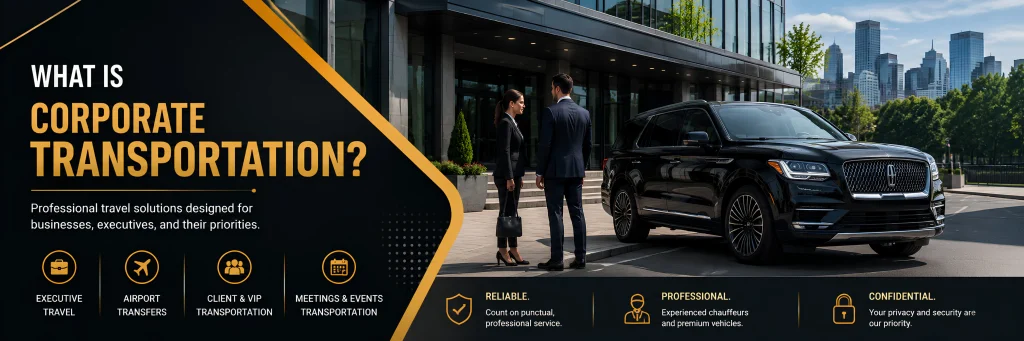
Corporate transportation is professional ground transportation arranged specifically for business-related travel.
Instead of relying entirely on employees to drive themselves, rent vehicles, use taxis, or request rideshare vehicles whenever transportation is needed, a company can work with a professional transportation provider to coordinate business travel.
Corporate transportation can include:
- Executive transportation
- Corporate airport transfers
- Business meeting transportation
- Client transportation
- VIP transportation
- Conference transportation
- Corporate event transportation Services
- Hourly chauffeur services
- Multi-stop transportation
- Executive roadshows
- Hotel transportation
- Group transportation
- Transportation for visiting executives
The exact service depends on the company’s needs. A business sending one executive from DCA to a downtown meeting may need a simple airport transfer.
A company hosting a visiting executive for two days may need airport transportation, hotel transfers, several meeting stops, and evening transportation.
A group attending a conference may require several vehicles or an organized shuttle schedule.
That flexibility is one of the reasons corporate transportation has become a useful business travel solution rather than simply a luxury service.
Why Do Businesses Invest in Corporate Transportation Services?
Businesses generally don’t invest in professional transportation simply because the vehicles look better. They invest because transportation affects other parts of the business.
The most important benefits include:
- Better use of executive time
- More predictable business travel
- Improved productivity
- Better client experiences
- Easier airport transportation
- More efficient multi-stop schedules
- Professional representation of the company
- Reduced transportation-related distractions
- Easier travel coordination
- Better support for corporate events
- Simplified billing and account management
- Greater flexibility for executives and teams
The value becomes more obvious when transportation is viewed as part of the company’s overall operations rather than as an isolated travel expense.
1. Businesses Invest in Transportation to Protect Executive Time
Time is one of the most expensive resources a company has.
An executive spending an hour dealing with traffic, parking, navigation, pickup coordination, and transportation logistics isn’t necessarily doing productive work.
Professional transportation changes that equation.
Instead of managing the vehicle, the executive can use the journey to:
- Review documents
- Prepare for a meeting
- Respond to emails
- Make calls
- Review presentations
- Organize notes
- Prepare questions
- Communicate with colleagues
- Take a break between meetings
The vehicle doesn’t make the road itself shorter. It can, however, change what the executive is able to do during that time. That distinction is important.
The business value isn’t simply faster transportation. It is a more productive use of transportation time.
This is particularly valuable for executives with schedules that move continuously between meetings, offices, airports, hotels, and events.
2. Corporate Transportation Can Improve Business Travel Productivity
Business travel can create small interruptions throughout the day.
An employee may have to:
- Find the vehicle
- Check directions
- Drive
- Find parking
- Pay for parking
- Walk to the destination
- Request another ride
- Coordinate pickup locations
- Deal with changing travel plans
Each task may seem insignificant. Together, they can consume a surprising amount of attention. With professional transportation, much of that responsibility moves away from the traveler.
The executive can remain focused on the reason for the trip. For companies that regularly send senior employees to meetings, conferences, client appointments, or business development activities, that can be a meaningful advantage.
3. Businesses Gain More Predictability
Business travel is rarely completely predictable.
- Meetings run late.
- Flights get delayed.
- Clients change locations.
- Events finish earlier than expected.
An executive may suddenly need to visit another office.
Professional transportation can give businesses more flexibility when these situations happen.
For example, an hourly chauffeur service can keep the same vehicle and chauffeur available while an executive moves between several locations.
Instead of booking a separate ride after every meeting, the transportation remains part of the itinerary.
Hourly as-directed service is commonly used for executives with multiple stops, investor roadshows, visiting delegations, and full-day business schedules.
That can be especially useful when the exact timing of every appointment isn’t guaranteed.
4. It Makes Complex Business Schedules Easier to Manage
A simple business trip might look like:
Airport → Hotel → Meeting → Airport
But a more complicated itinerary could be:
DCA → Hotel → K Street → Capitol Hill → Arlington → Georgetown → Hotel
Trying to arrange every movement individually can create unnecessary coordination.
A corporate transportation plan can organize the itinerary around the business schedule.
This is one reason companies with frequent executive travel may use hourly or as-directed transportation rather than relying entirely on individual point-to-point bookings.
The goal isn’t simply to provide transportation. The goal is to create continuity throughout the business day.
5. Businesses Use Corporate Transportation to Improve Client Experience
A client doesn’t experience your company only during the meeting.
Their experience can begin when they arrive at the airport.
If you’re hosting an important client or business partner, transportation can be part of the overall impression your company creates.
A professional transportation arrangement can help with:
- Airport pickup
- Hotel transfers
- Office visits
- Meeting transportation
- Business dinners
- Conference transportation
- Event transportation
Instead of asking a visiting client to figure out transportation in an unfamiliar city, the company can arrange the journey in advance.
That small detail can communicate organization and attention to detail. For businesses working with high-value clients, investors, executives, or visiting partners, those details can matter.
6. Corporate Airport Transportation Reduces Travel Friction
Airports are one of the most common reasons businesses arrange professional transportation.
Washington, DC businesses may need to coordinate travel through:
- Ronald Reagan Washington National Airport (DCA)
- Washington Dulles International Airport (IAD)
- Baltimore/Washington International Airport (BWI)
These airports have different locations and can create very different ground transportation requirements.
Corporate airport transportation can provide a planned connection between the airport and:
- Corporate offices
- Hotels
- Conference centers
- Meeting locations
- Client offices
- Event venues
Professional airport transportation providers may also offer flight monitoring and meet-and-greet services depending on the booking.
For businesses, the important advantage is having the ground transportation portion of the journey planned before the traveler arrives.
7. Professional Transportation Can Help Protect Meeting Schedules
Imagine an executive has an important presentation at 10:00 AM.
Their flight lands at 7:45 AM. They need to collect luggage, reach the hotel or office, prepare for the presentation, and arrive before the meeting begins.
Transportation becomes part of the meeting strategy. A delay doesn’t only affect the ride.
It can affect:
- Preparation time
- Meeting start time
- Client perception
- The following appointment
- The executive’s entire schedule
Professional transportation doesn’t eliminate traffic or unexpected events.
But a properly planned service can reduce the number of transportation decisions the traveler has to make. That can make the itinerary easier to manage.
8. Businesses Can Use Chauffeurs for Multi-Meeting Days
Some business trips require transportation throughout the entire day.
Consider an executive visiting Washington, DC for:
- 8:30 AM: Meeting downtown
- 10:30 AM: Government appointment
- 12:30 PM: Business lunch
- 2:00 PM: Client presentation
- 4:00 PM: Investor meeting
- 6:30 PM: Corporate dinner
This is not simply an airport transfer. It’s a transportation program.
An hourly chauffeur service can be useful in this situation because the vehicle remains available throughout the scheduled period. The executive doesn’t need to arrange a new vehicle after every meeting.
This model is particularly relevant for roadshows, executive programs, visiting delegations, and schedules involving multiple destinations.
9. Corporate Transportation Can Strengthen a Company’s Professional Image
Transportation may seem unrelated to branding.
But every customer-facing interaction contributes to how a company is perceived.
If a company is hosting:
- A potential investor
- A major client
- A visiting executive
- A strategic partner
- A conference speaker
- A board member
The transportation experience becomes part of the overall visit.
A professional chauffeur, appropriate vehicle, organized pickup, and clear communication can create a more polished experience.
This doesn’t mean a business needs the most expensive vehicle available. It means the transportation should match the importance and nature of the occasion. Professionalism is often more valuable than extravagance.
10. Businesses Invest in Privacy and Discretion
Executives sometimes need to discuss business while traveling.
They may be reviewing:
- Upcoming meetings
- Client strategy
- Business development
- Internal plans
- Presentations
- Schedules
- Sensitive company information
A private vehicle can provide a more appropriate environment than a crowded public transportation setting.
For industries where confidentiality is particularly important, businesses may also evaluate the transportation provider’s policies, chauffeur training, and approach to discretion before establishing a relationship.
Washington, DC’s corporate transportation market includes businesses such as law firms, government contractors, financial organizations, consulting companies, healthcare organizations, and technology firms where professional discretion can be particularly relevant.
11. Corporate Transportation Can Reduce Administrative Work
The executive isn’t the only person affected by transportation.
Executive assistants, office managers, travel coordinators, and event planners may spend significant time arranging business transportation.
Imagine managing transportation for:
- Five executives
- Three airports
- Four client meetings
- Two conferences
- Several hotels
- Multiple vehicles
Booking every ride separately can become an administrative task of its own. A corporate transportation provider may offer centralized booking and account management to simplify recurring transportation.
Depending on the provider, corporate accounts can include:
- Centralized reservations
- Authorized bookers
- Traveler profiles
- Recurring bookings
- Consolidated invoices
- Monthly billing
- Account support
These features are already being offered by corporate transportation providers serving Washington, DC businesses. The benefit isn’t only convenience. It’s reduced administrative friction.
12. Corporate Accounts Can Make Recurring Travel Easier
A company that books transportation once a year probably doesn’t need a complicated transportation program. But frequent travelers are different.
If a company regularly transports:
- Executives
- Employees
- Clients
- Consultants
- Speakers
- Business partners
A corporate account can create a more organized process. Instead of starting from scratch every time, the company can establish a consistent booking and billing workflow.
For travel managers and executive assistants, that can make recurring transportation much easier to administer.
13. Businesses Can Use Corporate Transportation for Events
Corporate transportation isn’t limited to individual executives.
Companies may need transportation for:
- Conferences
- Trade shows
- Corporate dinners
- Company celebrations
- Board meetings
- Networking events
- Client events
- Industry events
- Business conferences
- Group meetings
Large groups may require SUVs, Sprinter-style vehicles, shuttles, or larger group transportation depending on the number of passengers.
A transportation plan also helps coordinate arrival and departure times so employees and guests aren’t all trying to arrange transportation independently.
For large corporate events, transportation becomes a logistics issue rather than simply a ride.
14. It Can Help Companies Host Visiting Executives
A visiting executive may have a packed itinerary before arriving in the city.
The company may need to coordinate:
Airport → Hotel → Office → Client Meeting → Dinner → Hotel → Airport
Arranging transportation in advance can make the visit more organized. It also gives the host company greater control over the schedule.
This is particularly useful when the visitor is traveling from another city or country and may not be familiar with the Washington, DC area.
A dedicated transportation plan removes one more logistical responsibility from the visitor.
15. Corporate Transportation Can Support Investor Roadshows
Investor roadshows are a good example of why transportation needs can become complicated. An executive might have several meetings at different offices throughout the day.
The challenge isn’t simply getting from Point A to Point B. It’s maintaining the schedule across several locations.
A dedicated chauffeur can remain with the executive while the schedule progresses. This allows the transportation plan to adapt if one meeting runs longer or another location changes.
Hourly as-directed transportation is specifically marketed for investor roadshows and other multi-stop executive schedules in Washington, DC.
16. Businesses Can Reduce the Hidden Cost of Transportation
The price of a ride is only one part of transportation cost.
Businesses should also consider:
- Employee time
- Parking
- Vehicle rental
- Fuel
- Administrative work
- Travel coordination
- Missed appointments
- Delays
- Schedule disruptions
- Client inconvenience
For example, an employee who spends significant time driving, parking, and navigating isn’t simply using a vehicle.
They’re using company time. Likewise, an executive who misses part of a meeting because of transportation problems creates a cost that may never appear on a transportation invoice.
This is why businesses should evaluate total transportation value, not simply the lowest quoted fare.
17. The Cheapest Transportation Option Isn’t Always the Lowest-Cost Business Option
Suppose one transportation option costs less per trip. That doesn’t automatically make it cheaper for the business.
Consider two scenarios.
Option A
- Lower transportation price.
- The executive drives.
- They spend time navigating.
- They search for parking.
- They walk several blocks.
- They handle the next transportation leg themselves.
Option B
- Higher transportation price.
- A chauffeur handles the driving.
- The executive works during the journey.
- The vehicle remains available between meetings.
- Parking isn’t their responsibility.
- The business receives a more structured transportation experience.
- Option B may cost more on the invoice.
- But the business value can be different.
That is why corporate transportation decisions should consider time, productivity, reliability, and administrative effort alongside the transportation rate.
18. How to Think About Corporate Transportation ROI
Corporate transportation ROI isn’t always a simple calculation. However, businesses can evaluate several measurable areas.
Transportation Cost
How much is being spent on professional transportation?
Employee Time
How much time would employees spend driving, parking, and coordinating transportation themselves?
Executive Time
What is the approximate value of productive executive time?
Administrative Time
How much time does an assistant or travel manager spend arranging transportation?
Client Experience
Does professional transportation improve the experience of visiting clients and partners?
Schedule Reliability
How important is predictable transportation to the business itinerary?
Travel Volume
How frequently does the company require transportation? The more frequently a company travels, the easier it may become to evaluate the overall business value of a structured transportation program.
19. A Simple Corporate Transportation Value Formula
Businesses can create a basic internal framework:
Transportation Value = Time Saved + Administrative Efficiency + Productivity + Client Experience − Transportation Cost
This isn’t an accounting formula. It’s a way to think about the investment.
If transportation costs $X but saves executives and employees significant time, reduces administrative work, and supports important client relationships, the business should evaluate the total result rather than the ride price alone.
20. Corporate Transportation vs. Rideshare
Rideshare services can be useful for many everyday trips. The question isn’t whether rideshare is good or bad. The question is whether it fits the business requirement.
Rideshare may work well for:
- Simple point-to-point trips
- Short local journeys
- Flexible schedules
- Individual employees
- Low-priority transportation
Corporate transportation may be better suited to:
- Executive travel
- Important client transportation
- Airport transfers
- Multiple meetings
- Corporate events
- VIP guests
- Full-day schedules
- Recurring business travel
The difference is often control and consistency.
A business may prefer to know exactly how transportation is being coordinated rather than asking every executive to arrange each trip independently.
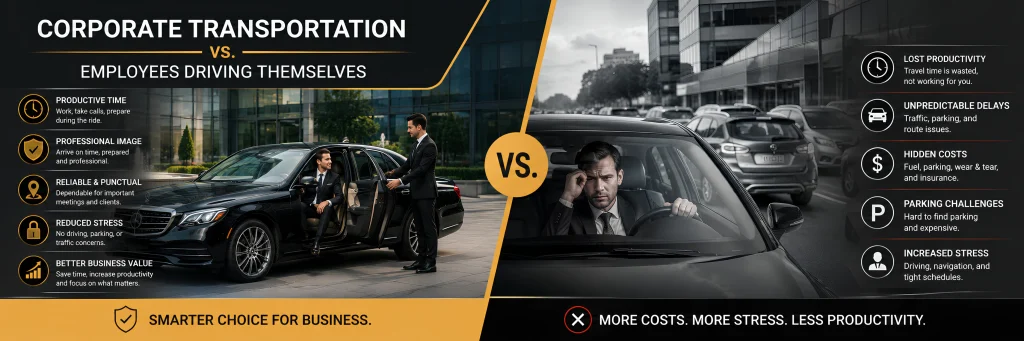
21. Corporate Transportation vs. Employees Driving Themselves
Allowing employees to drive themselves can appear simple. But it can introduce additional responsibilities.
Employees may have to:
- Navigate unfamiliar roads
- Find parking
- Pay parking fees
- Deal with traffic
- Manage rental vehicles
- Coordinate fuel
- Handle vehicle returns
- Focus on driving rather than preparing for meetings
For an ordinary local appointment, that may be perfectly reasonable. For a high-value executive itinerary, the calculation can be different.
The business should ask whether the employee’s time is better spent driving or working.
22. How to Choose a Corporate Transportation Service
Not every transportation company is designed for corporate clients. Before selecting a provider, businesses should evaluate several factors.
Professional Chauffeurs
Look for experienced chauffeurs who understand business etiquette, punctuality, communication, and discretion.
Appropriate Fleet
Make sure the provider can supply vehicles that match your passenger count, luggage, and business requirements.
Airport Coverage
If your employees travel frequently, confirm service for the airports they actually use.
Hourly Service
This can be valuable for executives with multiple meetings and changing schedules.
Corporate Accounts
Frequent users should ask about account management, billing, and recurring bookings.
Communication
Businesses need a reliable way to communicate changes and special instructions.
Service Area
Confirm coverage across Washington, DC, Northern Virginia, and Maryland if your business operates throughout the region.
Booking Process
The reservation process should be straightforward for both travelers and executive assistants.
Pricing Structure
Understand what affects the price, including vehicle type, distance, duration, and service structure.
The objective isn’t simply to choose a company with luxury vehicles. It’s to find a provider capable of supporting your business transportation workflow.
Frequently Asked Questions
Why do businesses invest in corporate transportation services?
Businesses invest in corporate transportation to improve executive travel, save productive time, simplify transportation coordination, support clients and visitors, manage complex schedules, and create a more consistent business travel experience.
Is corporate transportation worth the cost?
It can be, particularly for companies with frequent executive travel, client transportation, airport transfers, multi-stop schedules, or important business events. Businesses should evaluate total value rather than comparing transportation prices alone.
How does corporate transportation save businesses money?
It can reduce hidden costs associated with employee driving, parking, transportation coordination, lost productivity, and inefficient travel arrangements. The actual savings depend on the company’s travel volume and requirements.
How does chauffeur service improve executive productivity?
A chauffeur handles the driving and transportation logistics, allowing the executive to use travel time for calls, emails, preparation, reading, or rest.
What is included in corporate transportation?
Corporate transportation may include executive car service, airport transfers, hourly chauffeur service, client transportation, meeting transportation, event transportation, group transportation, and multi-stop travel.
Is corporate transportation only for executives?
No. Businesses can arrange transportation for employees, clients, visiting executives, speakers, business partners, conference attendees, and other guests.
Can companies arrange airport transportation for clients?
Yes. Businesses can arrange airport pickups and drop-offs for clients and visiting executives, including transportation to hotels, offices, conference centers, and other destinations.
Does corporate transportation include DCA, IAD, and BWI?
Many Washington, DC corporate transportation providers serve all three major airports. Businesses should confirm airport coverage and pickup procedures before booking.
What is hourly chauffeur service?
Hourly chauffeur service provides a dedicated vehicle and chauffeur for a specified period rather than requiring a separate reservation for every trip. It can be useful for executives with multiple meetings, roadshows, and changing itineraries.
Can a company open a corporate transportation account?
Many corporate transportation providers offer business accounts with features such as centralized reservations, account management, and consolidated billing. Availability and terms vary by provider.
What businesses benefit most from corporate transportation?
Law firms, consulting companies, financial organizations, technology companies, government contractors, healthcare organizations, associations, and companies with frequent executive or client travel can all benefit from professional corporate transportation.
How can a company measure corporate transportation ROI?
Companies can compare transportation costs against measurable factors such as executive time saved, employee productivity, administrative effort, client experience, travel efficiency, and the frequency of business transportation needs.
Final Thoughts
Businesses don’t invest in corporate transportation simply because they want a nicer ride.
They invest because time, reliability, productivity, client experience, and operational efficiency have business value. For an executive with one simple appointment, a regular rideshare or other transportation option may be completely adequate.
But when the itinerary includes an airport transfer, multiple meetings, important clients, a conference, a business dinner, and several destinations across the Washington, DC region, transportation becomes part of the day’s overall logistics.
That’s where professional corporate transportation can make a meaningful difference.
A company can use it to:
- Protect executive time
- Support productive travel
- Improve client experiences
- Simplify complex schedules
- Coordinate airport transfers
- Support corporate events
- Reduce transportation-related distractions
- Simplify recurring bookings
- Create a more professional travel experience
Need Corporate Transportation in Washington, DC?
If your company regularly manages executive travel, client visits, airport transfers, business meetings, corporate events, or multi-stop itineraries, professional transportation can be built around your actual schedule.
DC Elite Limo provides corporate transportation for business professionals and executives throughout Washington, DC, Maryland, and Virginia, with luxury vehicles and hourly chauffeur options for flexible business travel.
Plan your next business trip with a transportation service designed around your schedule, not the other way around.
Transportation Tips for Business Travelers
Corporate Event Transportation Planning: A Complete Guide for Washington DC Businesses
How Companies Save Time with Chauffeurs
Common Mistakes People Make When Booking Airport Transportation